

Why Can't Organisms Like Bacteria Grow To Large Sizes, Like The Size Of A Small Fish?
Unicellular vs. Multicellular
Unicellular vs. Multicellular
Cells office differently in unicellular and multicellular organisms. A unicellular organism depends upon just ane cell for all of its functions while a multicellular organism has cells specialized to perform unlike functions that collectively support the organism.
Image
frontonia protist
In that location are many types of unicellular organisms in the globe, including protists like this 1, which feed mainly on diatoms, amoebas, bacteria, and algae.
Photograph past Gerd Guenther / Science Source
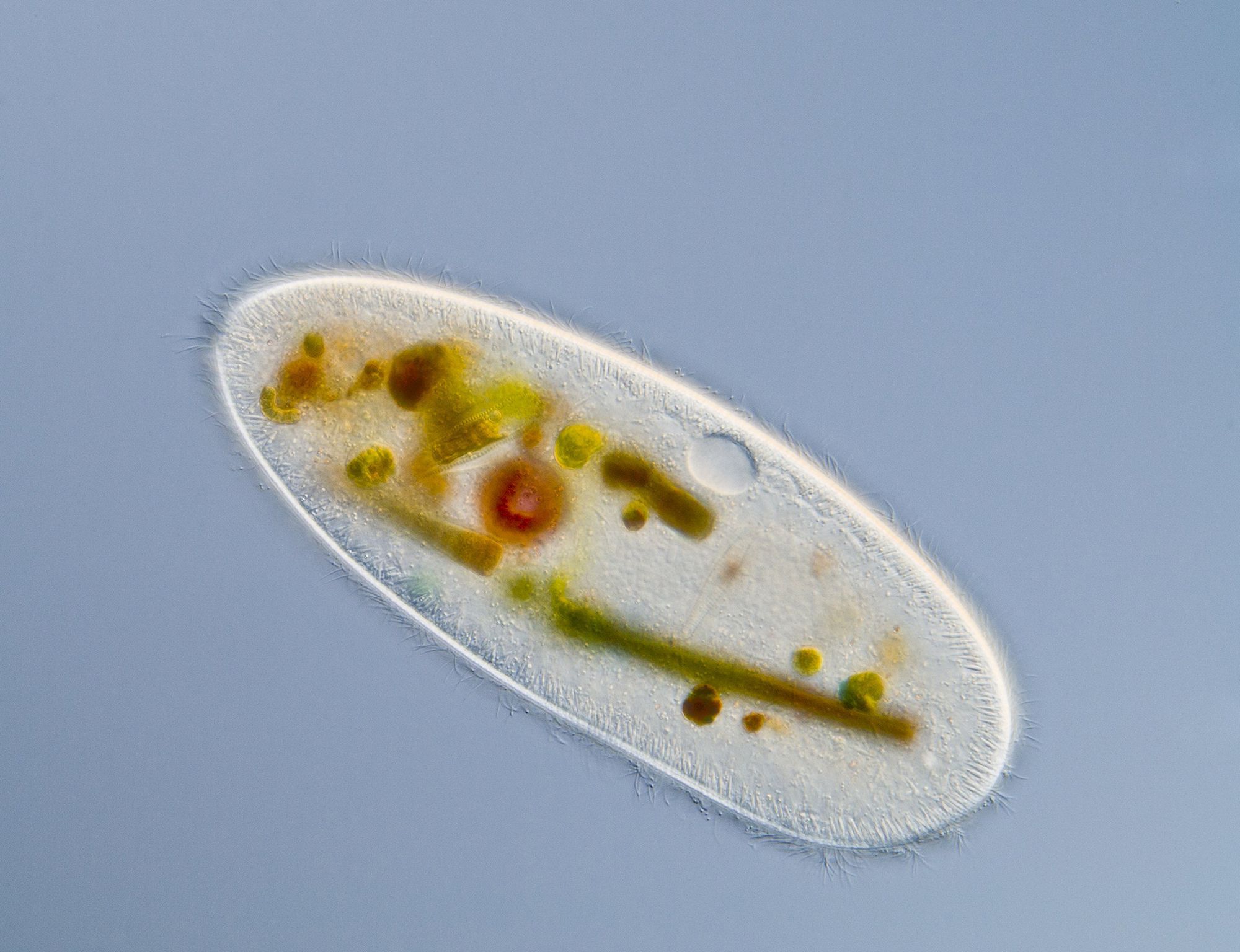
Cells function differently in unicellular and multicellular organisms, but in every organism, each cell has specialized prison cell structures, or organelles, of which there are many. These organelles are responsible for a variety of cellular functions, such as obtaining nutrients, producing free energy, and making proteins. Unicellular organisms are made upward of only one cell that carries out all of the functions needed past the organism, while multicellular organisms use many different cells to role. Unicellular organisms include bacteria, protists, and yeast. For example, a paramecium is a slipper-shaped, unicellular organism found in pond water. It takes in nutrient from the h2o and digests it in organelles known every bit food vacuoles. Nutrients from the food travel through the cytoplasm to the surrounding organelles, helping to keep the cell, and thus the organism, functioning. Multicellular organisms are composed of more than one cell, with groups of cells differentiating to have on specialized functions. In humans, cells differentiate early in development to become nerve cells, skin cells, muscle cells, blood cells, and other types of cells. 1 tin can easily notice the differences in these cells under a microscope. Their structure is related to their function, meaning each type of cell takes on a particular grade in order to all-time serve its purpose. Nerve cells accept appendages called dendrites and axons that connect with other nerve cells to move muscles, send signals to glands, or register sensory stimuli. Outer skin cells grade flattened stacks that protect the body from the environs. Muscle cells are slender fibers that bundle together for muscle contraction. The cells of multicellular organisms may likewise look dissimilar according to the organelles needed inside of the cell. For example, muscle cells accept more mitochondria than most other cells then that they can readily produce energy for movement; cells of the pancreas need to produce many proteins and have more ribosomes and crude endoplasmic reticula to meet this demand. Although all cells take organelles in common, the number and types of organelles present reveal how the prison cell functions.

There are many types of unicellular organisms in the globe, including protists similar this ane, which feed mainly on diatoms, amoebas, bacteria, and algae.
Photograph by Gerd Guenther / Science Source
axon
Noun
long projection from the neuronal body that conducts electrical impulses away from the neuron.
jail cell differentiation
Substantive
evolution of cells into a specific type of cells.
dendrite
Noun
branch that conducts electrical impulses toward the neuron.
endoplasmic reticulum
Noun
organelle that transports proteins.
enzyme
Substantive
proteins that advance the vital processes in an organism.
food vacuole
Noun
cell structure that digests food using enzymes.
golgi torso
Noun
organelle that packages proteins.
mitochondria
Plural Noun
(singular: mitochondrion) structure (organelle) in the cytoplasm of most cells in which nutrients (sugars, fatty acids, and amino acids) are broken downward in the presence of oxygen and converted to free energy in the form of ATP.
multicellular
Describing word
composed of more one cell.
organelle
Substantive
specialized part of a prison cell that performs a specific function.
paramecium
Substantive
slipper-shaped protist establish in pond water.
protist
Noun
type of microscopic organism (not an animal, plant, or mucus).
unicellular
Describing word
having i cell.

Why Can't Organisms Like Bacteria Grow To Large Sizes, Like The Size Of A Small Fish?,
Source: https://www.nationalgeographic.org/encyclopedia/unicellular-vs-multicellular/
Posted by: walstonagens1935.blogspot.com
0 Response to "Why Can't Organisms Like Bacteria Grow To Large Sizes, Like The Size Of A Small Fish?"
Post a Comment