

How Much Counterfeit Money Is In Circulation In The Us
We reflect upon the deeper significance of currency ( greenbacks ) in our lodge while looking at some of the challenges faced by Abraham Lincoln during the Ceremonious State of war
During the social and physical upheavals of the American Civil State of war, President Abraham Lincoln was faced with the unprecedented challenge of waging a successful military campaign against the recently seceded South while simultaneously attempting to broker the ultimate render of the Confederate States into the Wedlock.
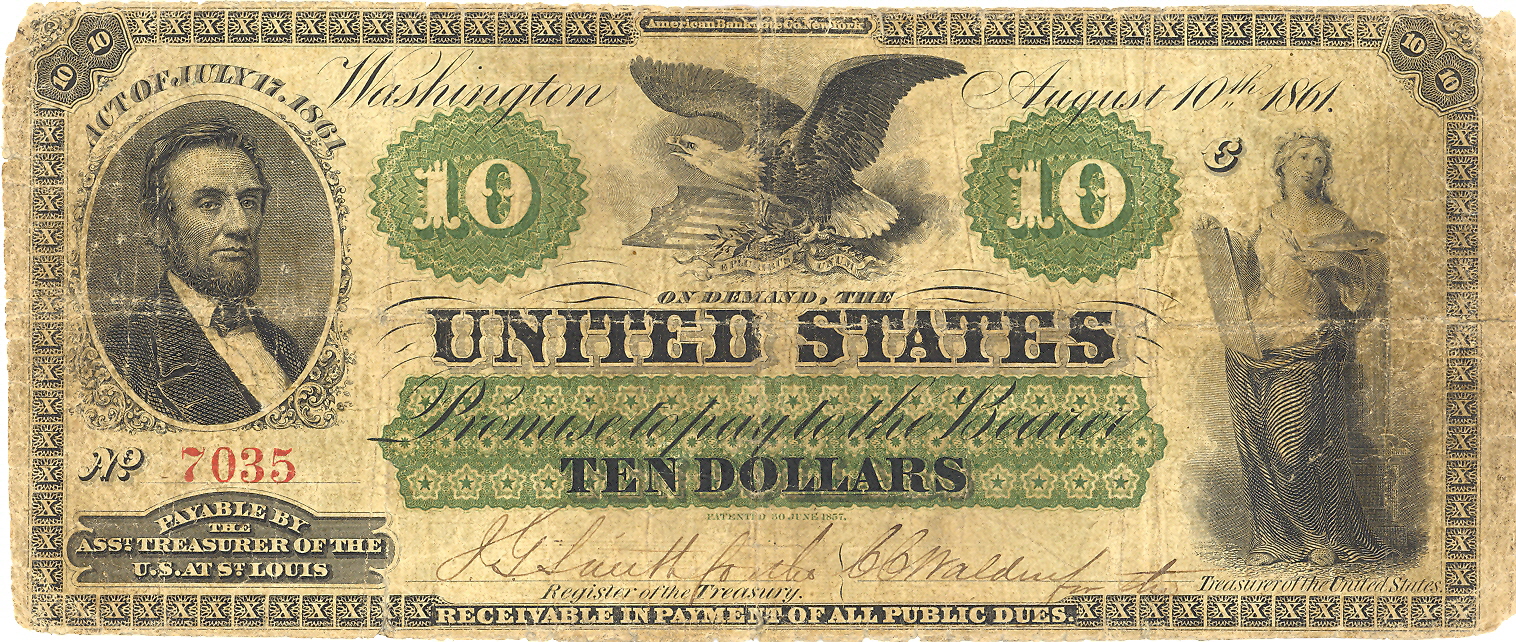
In response to the former, Lincoln was forced to enact what were – at the time – radical and divisive policies.
The dual strategy of authorizing the Section of the Treasury to print and release legal tender paper money and enlisting African-Americans to serve in the Union army was intended to aid in the Northward's execution of the increasingly unpopular war. Essentially, greenbacks immune Lincoln to finance the state of war that many northern African-Americans would now fight. Notwithstanding, the press of cash – much like the minting of African-American soldiers – was met with pregnant resistance, even unmasked hostility. If nosotros understand coin markets not only every bit systems of economic exchange but also every bit systems of symbolic commutation, we can brainstorm to unravel the shared linguistic communication of currency and race throughout U.S. history [ane] .
In the antebellum economy, the departure between representation and reality was oft exceedingly difficult to sort out. According to some estimates, every bit much as 40 percent of the money in apportionment in the Usa was counterfeit [2] . Equally useful to a nation struggling under the financial pressure of an expensive civil state of war and the budding entrepreneur seeking to advance forth the socioeconomic ladder, the value of paper money – in many ways – was derived from the willingness of the public to take it as genuine or reject information technology as ambiguous: apocryphal.
The same could be said of African-American soldiers during the Civil War. While some in the U.South. welcomed the addition of new recruits to the ranks of an army ravaged by defeat and disorganization in the early on days of the conflict, still others expressed disdain – even hysteria – at the thought of arming African-Americans and allowing them to stand and fight aslope white soldiers. The possibility of improving their condition within U.S. society through military service compelled many African-Americans to bear enormous oppression and hardship on the battlefield and at dwelling house throughout the Civil State of war. To many white Americans in the North also every bit the Due south, nevertheless, African-American soldiers were considered imitation representations of the "genuine" thing: white soldiers. Much like their greenback brethren, African-American soldiers were often equated as counterfeit. In the Us during the mid-nineteenth century, "the greenback represented the aspiring denizen's want to get ahead, the greenback also suggested the possibility of a world in which people might simply declare themselves whatever they liked… the aspiring Negro [sic] might declare himself equal, or at least erase the 'value' of the deviation betwixt white and blackness." Although neither money nor race is real: both are representations of social, economic, and – at times – racial deviation and what it means, "representations of what we are and what nosotros might become (O'Malley, 115-116)."
Every bit nosotros in the United States find the upcoming 157th Ceremony of the American Civil War, we can also take this time to reflect on the signifying power invested in the currency of the United States besides every bit other nations across the world. In many ways paper coin has always held greater significance than a mere medium of exchange. From allegories of freedom, justice, and commerce to portraits of venerated political leaders, paper coin has served as a widely circulated avenue of cultural and social exchange throughout history. Among the violence and tumult of the Civil War, greenbacks came to symbolize both force and national unity on the i manus, as well as regional and racial sectionalization on the other. So the next time you scan your collection: accept a closer await. History is printed on every annotation.
* * *
Notes
[1] For an excellent discussion on the relationship between U.Due south. paper coin and race upon which much of this article is based, encounter Michael O'Malley's Rags, Blacking, and Paper Soldiers: Coin and Race in the Civil War (2008), besides as in The Cultural Turn in U.South. History: Past, Present, Future, ed. James W. Cook, Lawrence B. Glickman, & Michael O'Malley, 95-120. Chicago, IL: University of Chicago Press.
[2] See Stephen Mihm, A Nation of Counterfeiters: Capitalists, Con Men, and the Making of the United States (Cambridge, MA, 2007); David R. Johnson, Illegal Tender: Counterfeiting and the Secret Service in Nineteenth-Century America (Washington, DC, 1995); Lyn Glaser, Counterfeiting in America (New York, 1968), 104-5; Murry T. Bloom, Money of Their Own (Port Clinton, OH, 1982), 101-three.
PMG-Certified United States Need Notes Currently Available on eBay
[wpebayads]
Source: https://coinweek.com/paper-money-2/fake-money-greenbacks-counterfeit-soldiers-on-the-eve-of-the-american-civil-war/
Posted by: walstonagens1935.blogspot.com
0 Response to "How Much Counterfeit Money Is In Circulation In The Us"
Post a Comment